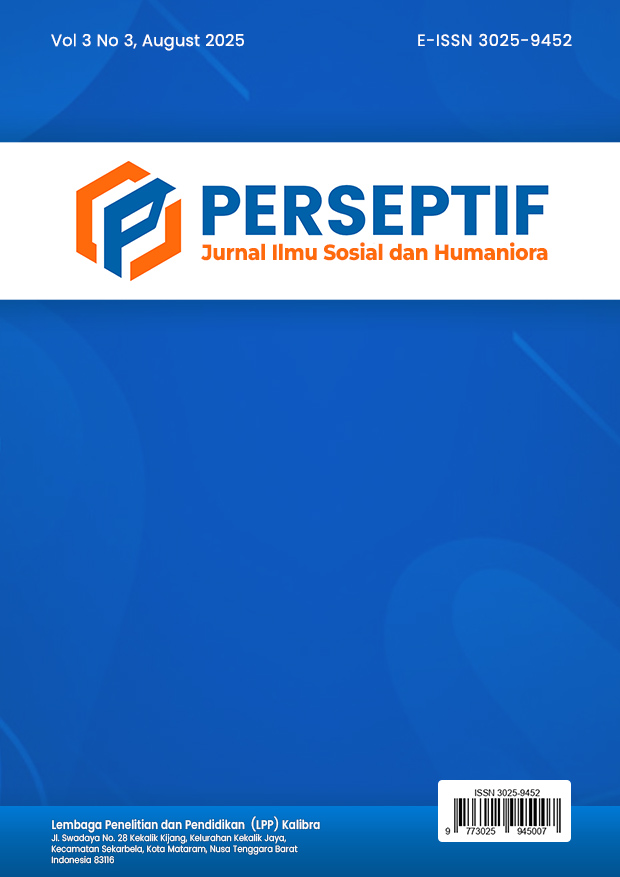
Transformasi Relasi Sosial Akibat Kecerdasan Buatan dalam Praktik Kerja Kreatif Humaniora Digital
DOI:
https://doi.org/10.70716/perseptif.v3i3.440Keywords:
artificial intelligence, digital humanities, creative labor, social relations, human co-creationAbstract
The development of artificial intelligence has brought significant changes to digital humanities practices, particularly in creative work that involves the production and interpretation of cultural knowledge. This study aims to analyze the transformation of social relations resulting from the integration of artificial intelligence into creative work practices in digital humanities. The main focus is on changes in interaction patterns, collaboration structures, role distribution, the formation of professional identities, and ethical dynamics that emerge in relations between humans and AI systems. The study adopts an interpretative qualitative approach with a multiple case study design. Data were collected through in-depth interviews, limited participant observation, and analysis of digital artifacts produced in AI-based creative practices. Data analysis was conducted thematically to identify patterns of social relations and meanings constructed by creative workers. The findings show that artificial intelligence is no longer positioned solely as a technical tool, but as a relational entity that plays an active role in the creative process. The presence of AI shifts interaction patterns toward hybrid human–machine relations, reconfigures work collaboration, and influences the legitimacy and identity of creative workers. This transformation is ambivalent. It opens opportunities for creative exploration while also generating tensions related to authority, the value of creativity, and inequalities in access to technology. This study emphasizes the importance of a critical digital humanities approach that is oriented toward human values in responding to the integration of artificial intelligence. The findings are expected to provide empirical and conceptual contributions to the development of digital humanities studies in the era of artificial intelligence.
References
Adorni, G., & Bellini, E. (2025). Towards a manifesto for cyber humanities: Paradigms, ethics, and prospects. arXiv. https://doi.org/10.48550/arXiv.2508.02760
Bird, C. (2024). Artists and AI: Creative interactions and tensions. In Proceedings of the ACM Conference on Creativity and Cognition (pp. 1–12). Association for Computing Machinery. https://doi.org/10.1145/3613905.3651041
Carassai, M. (2022). Digital humanities and the humanistic tradition. In M. Carassai (Ed.), Digital humanities and the human condition (pp. 1–20). Routledge. https://doi.org/10.4324/9781003046004-19
Frontoni, E., Paolanti, M., Migliorelli, L., Santini, S., & Zellou, G. (2024). Editorial: Artificial intelligence: The new frontier in digital humanities. Frontiers in Computer Science, 6, Article 1529826. https://doi.org/10.3389/fcomp.2024.1529826
Fridlund, M., Alfter, D., Brodén, D., Johansson, F., & Paju, P. (2024). Humanistic AI: Towards a new field of interdisciplinary expertise and research. In Proceedings of the Digital Humanities Conference 2024 (pp. 1–12). Linköping University Electronic Press. https://doi.org/10.3384/ecp205016
Hsu, G., & Bechky, B. A. (2024). Exploring the digital undertow: How generative AI impacts social categorizations in creative work. Organization Theory, 5(3), 1–25. https://doi.org/10.1177/26317877241275118
Kapadni, P. P. (2025). Digital humanities in the age of AI: Transforming human expression and global knowledge sharing. International Journal of Global Humanities and Multidisciplinary Insights, 1(1), 1–12. https://doi.org/10.63665/ijghmi.v01i01.02
Karpouzis, K. (2025). AI, digital humanities, and the legacies of colonial power. Preprints. https://doi.org/10.20944/preprints202502.1823.v1
Kyomugisha, A. T. (2025). The intersection of art and technology: Digital creativity. Regional Journal of Information and Communication and Media Studies, 4(1), 1–15. https://doi.org/10.59298/rijciam/2025/414346
Liu, J., Wang, Z., Xie, J.-W., & Zhang, Y. (2024). From ChatGPT, DALL·E 3 to Sora: How has generative AI changed digital humanities research and services? arXiv. https://doi.org/10.48550/arXiv.2404.18518
Lundman, R.-M., & Nordström, P. (2023). Creative geographies in the age of AI: Co-creative spatiality and the emerging techno-material relations between artists and artificial intelligence. Transactions of the Institute of British Geographers, 48(3), 567–582. https://doi.org/10.1111/tran.12608
Öztaş, Y. E., & Arda, B. (2025). Re-evaluating creative labor in the age of artificial intelligence: A qualitative case study of creative workers’ perspectives on technological transformation in creative industries. AI & Society. Advance online publication. https://doi.org/10.1007/s00146-025-02180-6
Ravochkin, N. (2023). Artificial agents of social relations. Iskusstvennye Obŝestva, 18(1), 1–17. https://doi.org/10.18254/s207751800024813-3
Roy, D., & Deshbandhu, A. (2024). Digital humanities. The Year’s Work in Critical and Cultural Theory, 32, 1–18. https://doi.org/10.1093/ywcct/mbae019
Sarkar, A. (2023). Exploring perspectives on the impact of artificial intelligence on the creativity of knowledge work: Beyond mechanised plagiarism and stochastic parrots. In Proceedings of the ACM Conference on Human Factors in Computing Systems (pp. 1–14). Association for Computing Machinery. https://doi.org/10.1145/3596671.3597650
Smithies, J. (2017). Artificial intelligence, digital humanities, and the automation of labour. In J. Smithies (Ed.), The digital humanities and the digital modern (pp. 67–85). Palgrave Macmillan. https://doi.org/10.1057/978-1-137-49944-8_4
Sun, J. (2024). AIGC fusion exploration: The intersecting path of digital humanities and artificial intelligence. Journal of Electrical Systems, 20(2), 1–10. https://doi.org/10.52783/jes.1181
Zhang, C., Shao, Y., Yuan, Y., & Liu, H. (2025). Artificial intelligence reshapes creativity: A multidimensional evaluation. PsyCh Journal. Advance online publication. https://doi.org/10.1002/pchj.70042
Zhao, H. (2023). Challenges or opportunities: When artificial intelligence is applied to digital humanities. Tidskrift för ABM, 8(1), 1–12. https://doi.org/10.33063/tabm.v8i1.548
Downloads
Published
Issue
Section
License
Copyright (c) 2025 Hamdan Hakim, Teuku Ilham Aziz (Author)

This work is licensed under a Creative Commons Attribution-ShareAlike 4.0 International License.