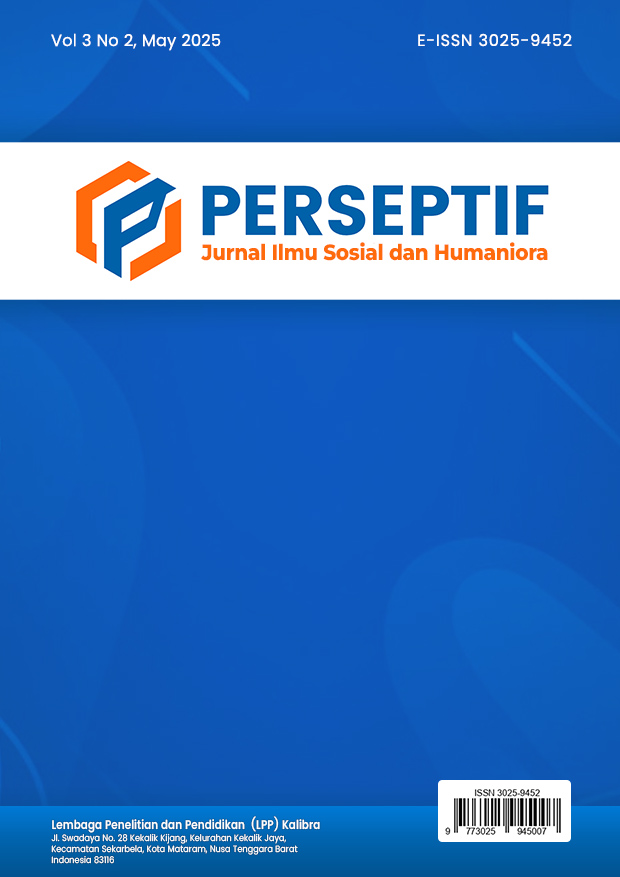
Konstruksi Etika Publik dalam Tata Kelola Algoritma Media Sosial di Masyarakat Demokratis
DOI:
https://doi.org/10.70716/perseptif.v3i2.437Keywords:
public ethics, social media algorithms, digital governance, democracy, digital platformsAbstract
Social media algorithms have become central actors in shaping the digital public sphere in democratic societies. Through mechanisms of curation, recommendation, and content moderation, algorithms influence the distribution of information, the formation of public opinion, and patterns of civic participation. This study aims to analyze the construction of public ethics in the governance of social media algorithms by positioning it as a normative, structural, and institutional issue. The main focus is on how the principles of justice, transparency, and accountability are articulated and implemented in algorithmic management practices by digital platforms. This study adopts a qualitative approach with a normative critical research design and conceptual analysis. Data are obtained through a systematic literature review of academic studies, policy reports, and institutional documents relevant to platform economies, digital regulation, and algorithmic ethics. The analysis links conceptual empirical findings with frameworks of public ethics and democratic governance. The findings indicate that current social media algorithm governance is still dominated by commercial logic and technical efficiency, which marginalize public ethical considerations. This condition produces transparency deficits, weak accountability mechanisms, and increasing power asymmetries between platforms and users. This study underscores the need to reconstruct algorithm governance by positioning algorithms as digital public infrastructure. Such reconstruction requires systematic policy intervention, meaningful public participation, and the strengthening of social justice principles to safeguard the quality of democracy in the digital era.
References
Aragüez Valenzuela, L. D. (2022). La configuración del algoritmo digital, vacíos de justicia y principales desafíos para el derecho del trabajo. e-Revista Internacional de la Protección Social, 7(1), 1–22. https://doi.org/10.12795/e-rips.2022.i01.02
Badger, A., Bertolini, A., Graham, M., & Joyce, S. (2023). Fairness in the platform economy: Lessons learnt from a pandemic. In A. Badger et al. (Eds.), The platform economy and the pandemic (pp. 1–20). Edward Elgar Publishing. https://doi.org/10.4337/9781803926155.00010
Deakin, S. (2011). The fortieth anniversary of the Industrial Law Journal. Industrial Law Journal, 40(1), 1–7. https://doi.org/10.1093/indlaw/dwr001
Gomes, B. (2018). Le droit du travail à l’épreuve des plateformes numériques (Doctoral dissertation). Université Paris Nanterre.
González Cobaleda, E. (2021). La regulación del trabajo de plataformas en línea: Puntos críticos más allá de la punta del iceberg. Revista de Trabajo y Seguridad Social, (459), 1–29. https://doi.org/10.51302/rtss.2021.2416
Hasibuan, R., Abdillah, M., Andini, N., & rekan-rekan. (2025). Kontrak kerja vs kontrak platform: Perbandingan perlindungan hukum bagi pekerja di era ekonomi digital. Konsensus, 2(3), 1–15. https://doi.org/10.62383/konsensus.v2i3.941
International Labour Organization. (2021). Ensuring decent work on digital labour platforms. International Labour Office. https://doi.org/10.1002/wow3.171
Kotlyarova, I. Y. (2025). Забезпечення справедливих умов праці та захист прав працівників у цифрову епоху: законодавчі ініціативи та судова практика. Aktualʹni Problemi Prava: Teoriâ ì Praktika, 50(2), 118–133. https://doi.org/10.33216/2218-5461/2025-50-2-118-133
Muntaner, C. (2018). Digital platforms, gig economy, precarious employment, and the invisible hand of social class. International Journal of Health Services, 48(4), 597–600. https://doi.org/10.1177/0020731418801413
Ó Siochrú, S., Singh, P., & Burch, S. (2023). Just net coalition: Seeking anchors of equity and social justice in a digital world. In Global transformations in media and communication research (pp. 251–270). Springer. https://doi.org/10.1007/978-3-031-29616-1_14
Oliveira, M. C. S., Carelli, R. L., & Grillo, S. (2020). Conceito e crítica das plataformas digitais de trabalho. Revista Direito e Práxis, 11(4), 2633–2665. https://doi.org/10.1590/2179-8966/2020/50080
Organisation for Economic Co-operation and Development. (2023). Executive summary. In The impact of digitalisation on labour markets. OECD Publishing. https://doi.org/10.1787/8ab9e151-en
Pei, R. (2023). Labor rights protection under platform economy: Legal challenges and innovative explorations. Science of Law Journal, 5(2), 45–60. https://doi.org/10.23977/law.2023.021219
Potocka-Sionek, N. (2018). Facing digital precariousness in the platform economy: On the way towards a more sustainable future of work. European Trade Union Institute.
Schmidt, F. A. (2017). Digital labour markets in the platform economy: Mapping the political challenges of crowd work and gig work. Friedrich-Ebert-Stiftung.
Sema, E., & Koçiaj, I. (2024). The role and importance of public policies: How do governments should intervene to protect the rights of employees in digital labour platforms. In ITEMA 2024 proceedings (pp. 457–465). https://doi.org/10.31410/itema.2024.457
Sfetcu, L. (2024). Strategies for sustainable growth and decent work in the platform economy. Technium Social Sciences Journal, 66(1), 1–15. https://doi.org/10.47577/tssj.v66i1.12120
Telychko, O. A., & Rekun, V. A. (2024). Analysis of legislation and judicial practice regarding the legal status and social guarantees of employees of digital platforms in EU countries: Challenges and perspectives. Analìtično-porìvnâlʹne Pravoznavstvo, (6), 68–79. https://doi.org/10.24144/2788-6018.2024.06.68
Tullini, P. (2018). L’economia delle piattaforme e le sfide del diritto del lavoro. Economia e Società Regionale, (1), 1–20. https://doi.org/10.3280/ES2018-001004
Vered, E. B., & Novradova-Vasiliadi, S. M. (2024). Problems and prospects for the development of legal regulation of platform employment. Public Policy and Administration, 9(1), 1–12. https://doi.org/10.33920/pol-2-2403-01
Downloads
Published
Issue
Section
License
Copyright (c) 2025 Muhtar Alatas, Syafrie Mangun Jaya, Ihdam Khalid (Author)

This work is licensed under a Creative Commons Attribution-ShareAlike 4.0 International License.